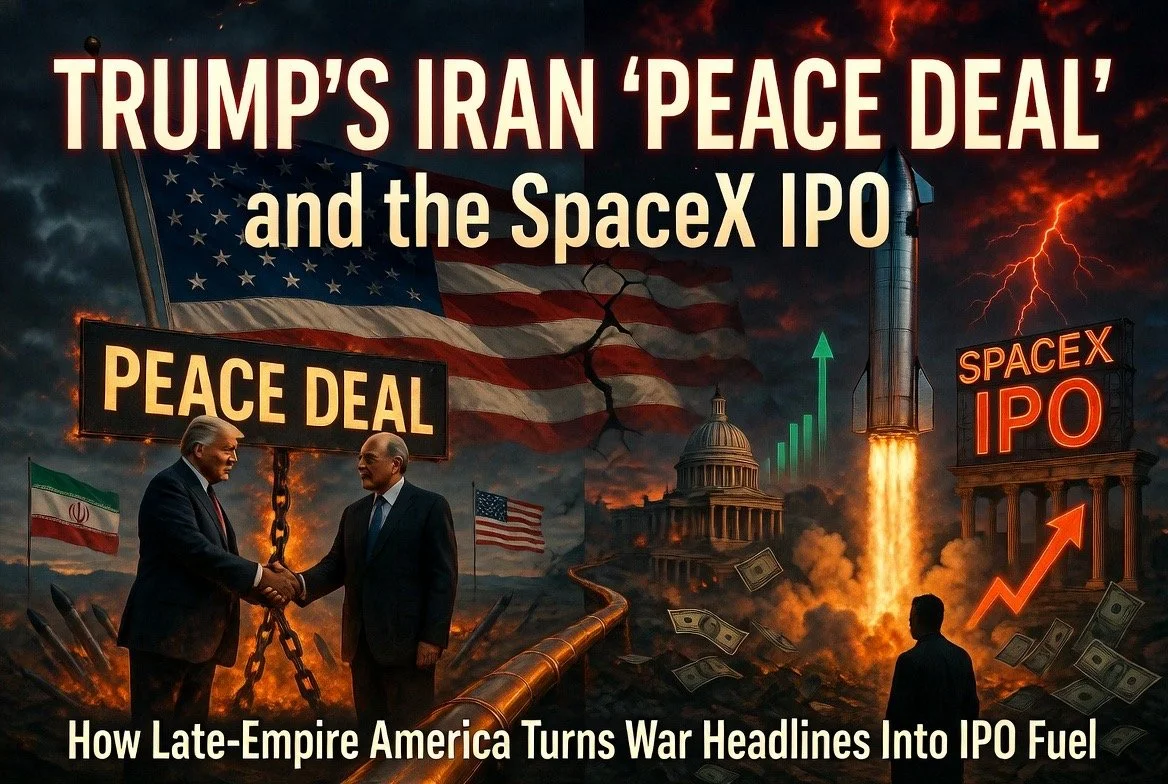
Trump’s Iran ‘Peace Deal’ and the SpaceX IPO: How Late‑Empire America Turns War Headlines Into IPO Fuel
(Chaz Anon) Trump’s Iran “peace deal” theatrics and the SpaceX IPO sit on the same stage: manufactured optimism, weaponized headlines, and a market that now trades presidential mood swings as if they were fundamentals.
In the days leading up to the supposed Iran deal “announcement,” markets were already conditioned to trade every Trump syllable as a macro event.
Threaten strikes, futures puke; hint “productive talks” and “total resolution,” and the S&P 500 rips higher while oil falls like someone found peace in the Middle East during a lunch break.
AP and others have already documented the pattern: Trump floats progress on Iran, stocks spike, oil sinks, and then Iran publicly denies any such breakthrough even took place.
On at least one of these mornings, the optimism hit right before US markets opened, turning what should have been a red day into an opportunistic rally.
Meanwhile, SpaceX is stepping onto the public markets with a blockbuster offering, targeting roughly 555.6 million shares at around 135 dollars a share to raise as much as 75 billion dollars.
At that valuation, some analysts estimate SpaceX trading at sky-high revenue multiples, the kind of pricing that absolutely depends on maximum liquidity and frothy risk appetite.
Financial media and analysts are already packaging the deal as a must-own “next decade” trade, while also quietly warning retail about the risk baked into that IPO price.
In other words, this thing doesn’t just need buyers; it needs euphoric, story‑drunk buyers willing to accept a nosebleed multiple as a patriotic duty to “own the future.”
So on cue, Trump signals that the “time and place” of an Iran deal signing will be “announced shortly,” and the S&P 500 obliges by ripping higher.
Right alongside that, oil slides, with benchmarks dropping sharply after reported postponements or cancellations of strikes on Iranian energy infrastructure.
We’ve seen this movie already: a social media post about “VERY GOOD AND PRODUCTIVE CONVERSATIONS” with Tehran, followed by hundreds of millions of dollars in oil trades placed just minutes before the announcement, perfectly positioned for an oil dump and equity squeeze.
BBC’s review of trading data showed a spike from tens to thousands of contracts in a couple of minutes, implying someone either guessed perfectly or knew exactly when the “peace” tweet was coming.
Geopolitical risk normally hits stocks first and then fades as the news gets digested, but here the uncertainty itself is being kept on a drip to manage price levels.
Trump’s Iran commentary swings between “obliterate” and “almost peace,” with markets lurching in sync, effectively turning foreign policy into an on-demand volatility machine.
When he hints at de‑escalation, equities catch a bid and oil dumps, papering over structural problems and giving risk assets just enough air under the wings to tackle the next big issuance calendar item—like, say, a record‑sized tech‑industrial IPO.
When he swings back to threats, you get a reset: a dip to buy for the well-informed and a reminder that the button is always “almost” about to be pushed.
An IPO at 135 dollars a share with a 75 billion dollar raise looks a lot more “reasonable” to the public when the index is green, volatility is down, and the financial media is blasting headlines about peace around a crucial oil chokepoint.
If you want that book well oversubscribed and trading above the offer on day one, the last thing you need is a full‑blown Iran panic and crude ripping back toward triple digits.
So you end up with this charming alignment:
• A president telegraphing “deal soon” with Iran, juicing stocks and knocking down oil.
• An options and futures market that seems to get advanced notice often enough to bet size before the announcement hits the public.
• A mega‑IPO that needs every marginal dollar of risk-on capital feeling brave and flush.
The result is not a free market; it is a sentiment management system where war headlines and peace rumors are toggled like dimmer switches to optimize corporate financing events.
From “geopolitical risk” to product feature
Traditionally, geopolitical shocks were treated as exogenous events that markets reluctantly priced in, then gradually faded.
Now, in the Trump era, geopolitical tension around Iran behaves more like a product feature: dial fear up to shake the tree, dial “peace is close” to trigger a relief rally when you need higher prices.
There are academic papers and asset‑manager notes showing that markets often recover from war scares within months, sometimes even outperforming afterwards, but that assumes the events are not being deliberately ridden like a surfboard by policymakers.
In this case, the timing pattern is too convenient: key Iran announcements land around market opens or sensitive news windows, precisely when they can do maximum work on indices, energy prices, and risk sentiment.
SpaceX’s IPO, pitched at a premium valuation with massive retail interest, is a perfect stress test for this new regime of narrative‑driven markets.
If the book is full and the stock trades cleanly above its issue price, the lesson to every future issuer is obvious: align your launch window with macro “good news” from the political theater, and let the state‑sponsored sentiment engine do the rest.
If it stumbles, we’ll see whether the response is more threats, more “48-hour ultimatums,” or another conveniently timed “we’ve made great progress” post to get the indexes and oil curve back into the right shape.
Either way, the precedent is set: in late‑stage empire, the line between foreign policy and IPO roadshow has dissolved.