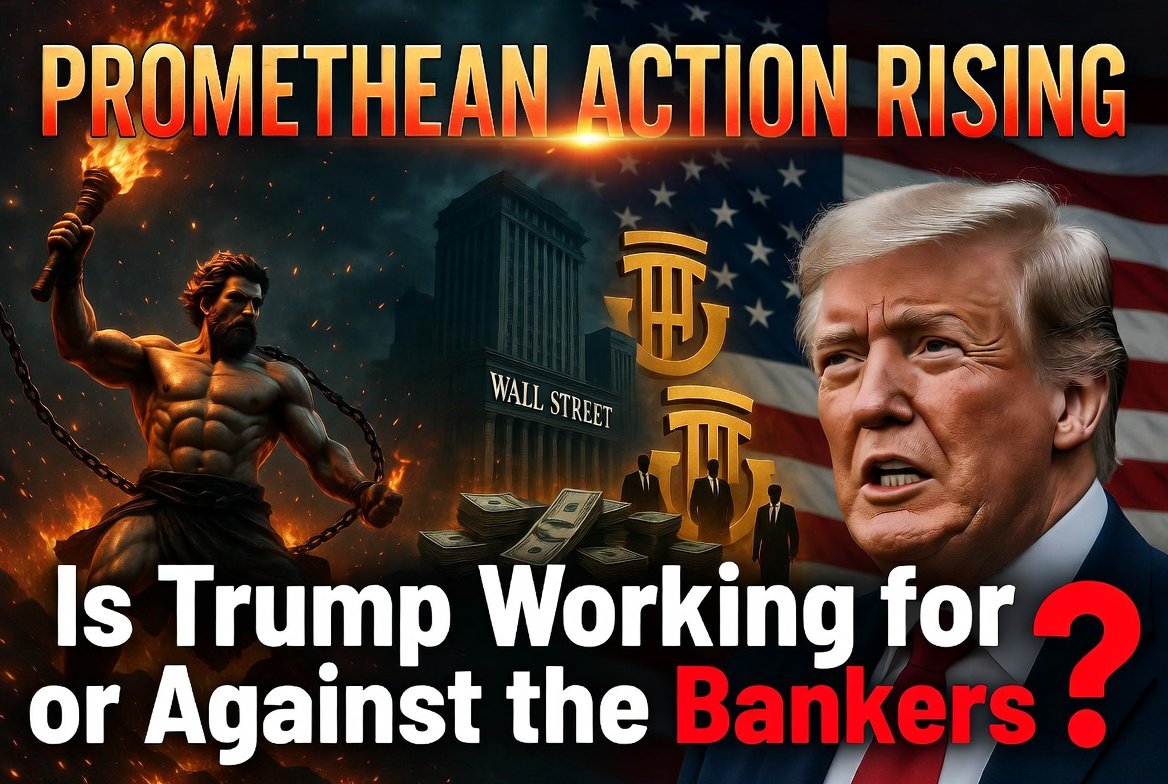
Promethean Action Rising: Is Trump Working for or Against the Bankers?
(Chaz Anon) We keep hearing that Trump is fighting the bankers. Not the bankers you can actually name or see in person, but the mythical-mystical bankers of the old invisible priesthood in the City of London. The esoteric empire behind the empire. It’s a neat little story for people who want to feel anti-establishment without ever actually leaving the approved theater of billionaire politics.
One of the PAC’s pushing this narrative is Promethean Action. They have turned the story into a full political cosmology: Trump as nationalist firebrand, London as vampire squid, Wall Street as compromised junior partner, and every prosecution, leak, sanction, or policy fight as proof that he is threatening the hidden masters of the age. There is certainly some truth to the idea that the City of London directs transnational capital (from the BIS in Switzerland). The problem is the reality that Trump moves through the same circuits of transnational capital, speculative finance, Gulf money, and security patronage that this narrative claims he is destroying.
The Promethean frame
Promethean Action presents itself as a movement dedicated to “defying oligarchy,” and its recent material repeatedly argues that Trump has opened a direct confrontation with the City of London and the old British imperial order. In this framework, Trump is not just another American president but the instrument of an “American System” revival against financial parasitism, offshore laundering, and a London-centered geopolitical cartel.
This framing is not incidental. It is the modern reworking of the LaRouche movement’s old thesis that the core enemy of productive society is a British imperial financial oligarchy, with Wall Street cast as its American operating arm. Many of the people behind Promethean Action come from LaRouche PAC, including the face of the operation Susan Kokinda, who repeatedly route crises in shipping, Middle East conflict, cartel violence, counterterrorism, and lawfare back to the City of London as the master node.
Why the story works
The narrative works because it gives people a villain large enough to explain everything: wars, austerity, deindustrialization, surveillance, and political corruption. It also gives Trump’s supporters a way to interpret every attack on him as proof that he threatens a hidden sovereign power above ordinary party politics.
That is a powerful political script because it converts systemic contradictions into a melodrama of empire versus nation. If Trump aligns with financiers, the alignment can be explained as tactical; if he is prosecuted, it confirms the enemy is real; if he courts oligarchic money, believers can say he is using the empire’s resources against itself.
The structural contradiction
The problem is that Trump is not outside the system of high finance. He is deeply embedded in it. Reporting in 2025 and 2026 showed Trump-linked crypto ventures offering top token investors access to Trump at private dinners and luncheons, with critics describing the arrangement as a blatant fusion of public office and speculative finance.
That is not a rebellion against “the bankers.” It is a new monetization layer inside the same financial order, one that merges celebrity politics, memecoin speculation, and influence markets. The form may be newer than old-line banking, but the logic is identical: capital buys proximity, speculation creates leverage, and political power becomes an asset class.
Transnational capital, not national liberation
The Promethean account also has trouble explaining Trump’s place within transnational capital. Their rhetoric displaces “the bankers” onto a quasi-external British enemy, but modern capital is not neatly split between patriotic industrial America and foreign imperial finance. It is networked across New York, London, Delaware, the Gulf monarchies, offshore jurisdictions, private equity, crypto vehicles, and defense-adjacent venture capital.
This is important because the same financial actors often move between civilian speculation, state contracting, and geopolitical dealmaking. Analysis of the contemporary military-industrial complex shows private equity and venture capital increasingly steering firms toward Pentagon markets, while Gulf sovereign wealth is embedded in the financing of military technologies and their downstream export regimes, including to Israel and other security partners. Trump’s political economy fits this terrain far better than the image of a lone nationalist insurgent besieged by “the City.”
Israel and the military-security circuit
Promethean’s worldview tends to route Middle East disorder back to London-centered imperial management, but the actual security architecture is more layered. The modern military-industrial complex is increasingly described as high-tech, intelligence-led, and modeled in part on Israeli practices of surveillance, targeting, and permanent security management. That does not make Israel the sole driver of the system, but it does place Israel inside the same web of defense capital, venture finance, intelligence outsourcing, and Gulf-backed technology flows that define twenty-first century empire.
This is where the Promethean script becomes selective. It can denounce the “British Empire” and the City of London, but it struggles to integrate the reality that Trump-friendly coalitions also operate through pro-Israel lobbying environments, Gulf investment circuits, defense entrepreneurs, and security-state contractors.
The Israeli ties to the City of London go back as far as the Balfour Declaration, which was of course pushed by the Rothschild banking dynasty. Trump’s business dealings have been heavily intertwined with that notorious banking family. Once those connections are visible, the alleged divide between Trump and “the bankers” starts to dissolve.
What the myth actually does
The phrase “the bankers” sounds radical because it implies a structural critique of concentrated financial power. But in the Promethean telling, that critique is narrowed into a redemptive hero story: Trump is the exception, the breaker of chains, the man who can somehow move through oligarchic money without being shaped by it.
That move is politically useful because it channels real anger at financialization into personal loyalty. Rather than asking whether Trump governs within the same imperial-financial architecture, the audience is invited to believe that any evidence of elite backing merely proves how desperate the enemy has become.
The harder reading
A harder reading is that Trump is not outside the bankers’ system but one of its most adaptive political expressions. He may clash with particular factions, regulators, bureaucracies, or foreign-policy styles, but that is different from waging war on transnational finance itself.
The deeper continuity is visible in the convergence of speculative finance, sovereign money, military technology, intelligence politics, and access brokerage. Once that convergence is in frame, the question is no longer whether Trump is “for” or “against” the bankers in moral terms; it is which factions of capital he represents, how he arbitrages between them, and why movements like Promethean need to narrate him as a liberator rather than a participant.
That structure is effective because it feels oppositional while remaining strategically containable. It can absorb anger over central banking, military profiteering, deindustrialization, or foreign policy without letting that anger develop into a broader critique of American capital, Israeli security integration, Gulf money, venture militarization, or the role of Trump himself inside those systems.
Why the network matters
Promethean PAC is not large by mainstream standards, but it matters as a relay mechanism between an older conspiratorial anti-finance tradition and newer populist information warfare. It preserves cadre discipline, ideological consistency, and an archive of movement doctrine while adapting its message to the emotional needs of the current moment.
For that reason, the network should be read less as a fringe curiosity than as a case study in controlled anti-oligarchic politics. It turns diffuse anxieties about empire into a single script, then resolves that script in favor of Trump, even when the underlying architecture of transnational capital and the military-industrial complex points in a much more complicated direction.
Coming Soon:
PART 2 History of Promethean Action