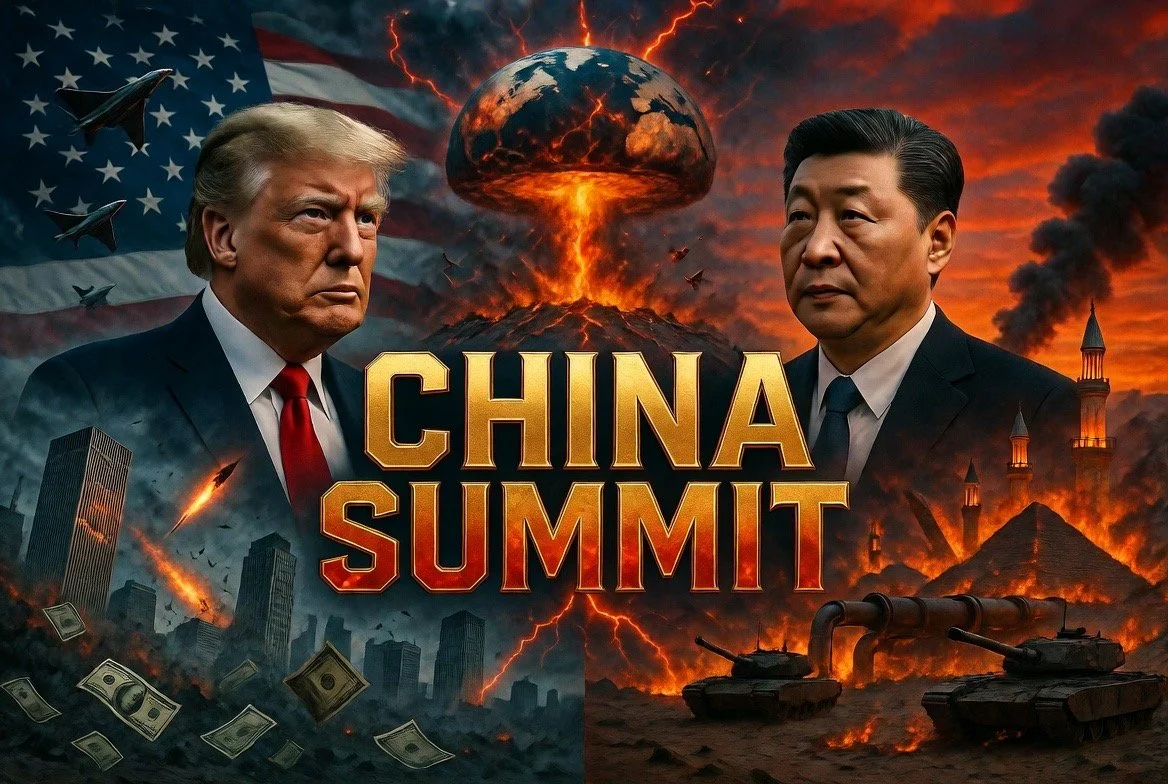
Trump’s High-Stakes China Summit: Puppets, Power, and Oligarchy
(Chaz Anon) There are state visits, there are trade delegations—and then there is whatever this is.
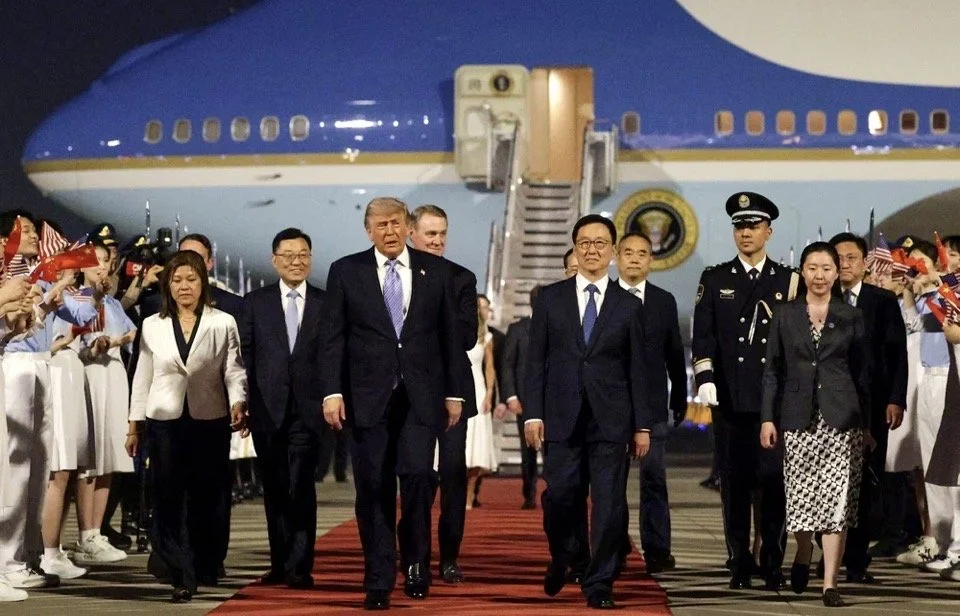
The President of the United States boarding a plane to China, flanked not by diplomats but by the upper command of American corporate power. This is not a normal event. There is no precedent for this scale, this concentration, this level of alignment between state authority and private capital moving in lockstep toward a geopolitical counterpart.
Trump boarded Air Force One with the likes of Musk. Huang. Cook. Fink. Schwarzman. A traveling boardroom of empire. They are en route to Beijing—not for ceremony, but for negotiation.
This is not diplomacy in the traditional sense. This is something closer to a syndicate summit.
And that’s just the visible layer.
Trump calls it “making deals.” That word does a lot of work. It reduces something systemic into something transactional, something personal, almost casual. But what’s actually happening here isn’t a dealmaking trip. It’s a systems negotiation between interdependent power structures trying to stabilize themselves under mounting strain.
Because Trump, for all the mythology built around him, does not operate as an isolated actor. He sits inside a hierarchy.
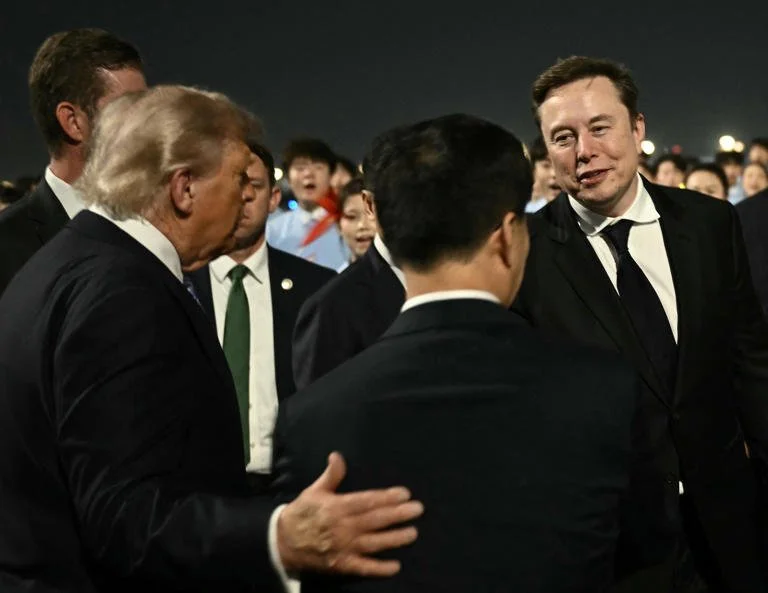
He answers upward to an executive management layer of political lobbying, capital flows, and influence networks that translate policy into profit. That layer is sitting on the plane with him. These CEOs are not just business leaders; they are intermediaries between state power and financial extraction, tasked with converting geopolitical positioning into material outcomes—contracts, access, regulatory advantages, market continuity.
Because what’s unfolding here is not just a meeting between Trump and Xi. It is a convergence between two systems that, for decades, pretended to be adversarial while quietly growing dependent on one another. The political theater of rivalry—trade wars, sanctions, rhetorical hostility—has always masked a deeper entanglement: supply chains, capital flows, technological dependencies, and mutual leverage at a scale too vast to unwind.
Now, that entanglement is being made explicit.
Look at the roster. Nvidia and Qualcomm—gatekeepers of the semiconductor future. Apple—architect of the global consumer ecosystem, deeply fused with Chinese manufacturing. BlackRock and Blackstone—custodians of capital that flows across borders regardless of flags. Boeing, Cargill, Citigroup, Goldman Sachs—each a pillar of industrial, agricultural, or financial infrastructure. These are not companies; they are instruments of systemic continuity.
And they are all going, in person, to negotiate.
That alone should raise a more unsettling question: who, exactly, is representing whom?
Because when CEOs of this magnitude accompany a sitting president to “request deals,” the hierarchy becomes ambiguous. Is the state leading capital or is capital bringing the state along as its enforcement arm? The optics suggest something closer to the latter: a synchronized approach where national policy and corporate interest are no longer merely aligned, but operationally fused.
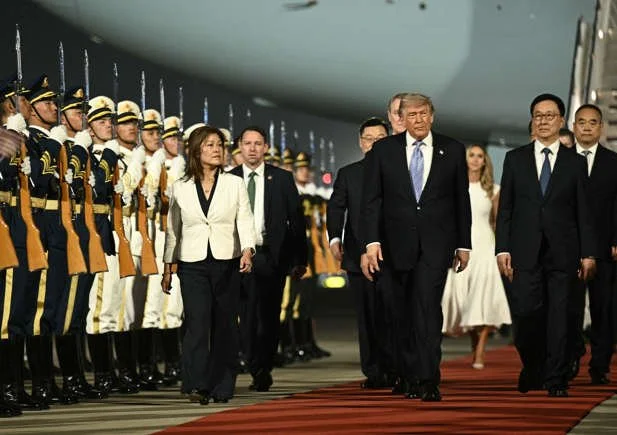
This is what late-stage globalization looks like.
For years, the narrative was decoupling. Economic separation. Strategic independence. Yet here we are, witnessing the opposite. A high-level pilgrimage to stabilize, renegotiate, and possibly deepen the very interdependencies that public rhetoric insists are being dismantled.
And Xi understands this dynamic perfectly.
This meeting is not just about “deals.” That word is almost comically insufficient. This is about recalibrating the architecture of global power under conditions of rising instability. Technology chokepoints, financial fragility, supply chain vulnerabilities—all of it is on the table.
But these big names don’t sit at the top of the pyramid. They are the faces in the theatre of politics.
Executives answer to boards. Boards answer to shareholders. And the largest shareholders are not individuals, but institutions like BlackRock, Vanguard, State Street, JPMorgan, Goldman Sachs, Citi. Capital aggregators on a planetary scale, managing trillions in assets, quietly shaping outcomes not through headlines but through allocation.
This is the Financial-Industrial Complex in its mature form: diffuse, interlocking, and largely invisible unless you know where to look.
And even that layer is not the apex.
Above it sits a more opaque stratum of sovereign wealth funds, dynastic family offices, central banking networks, legacy fortunes accumulated across centuries of empire, war, trade, and resource control. Energy monopolies. Strategic commodities. Old capital that does not need visibility because it already has permanence.
When you see a sitting U.S. president arrive in Beijing with a portable cross-section of the American corporate and financial system, what you’re really seeing is an interface between complexes:
• The Financial-Industrial Complex (capital allocation, debt systems, liquidity maintenance)
• The Technological-Industrial Complex (semiconductors, AI infrastructure, platform dominance)
• The Military-Industrial Complex (defense, aerospace, strategic deterrence)
These are not separate silos anymore. They are converging systems, increasingly forced to coordinate as the global order becomes more fragile.
And right now, the Financial-Industrial Complex rules supreme.
Because beneath all the rhetoric—trade wars, national security, ideological rivalry—sits a more immediate problem: the sustainability of the dollar-based global system itself.
Call it what you want—reserve currency privilege, debt-driven growth, or, more bluntly, a rolling refinancing mechanism that requires constant expansion to avoid contraction. The U.S. system depends on liquidity, on demand for its financial instruments, on the continued recycling of capital through its markets.
And that system is under pressure.
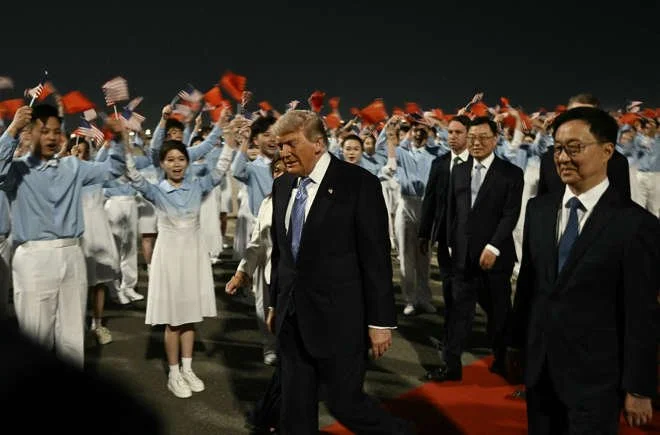
China holds leverage. Not absolute control, but enough interdependence in manufacturing, in supply chains, in capital markets to force negotiation. Decoupling, despite years of political theater, has proven to be more narrative than reality.
So this trip is not about confrontation. It’s about calibration.
How do you maintain technological competition without severing supply chains?
How do you impose financial pressure without triggering systemic backlash?
How do you preserve dollar dominance while the rest of the world quietly experiments with alternatives?
And most importantly:
How do you keep the machine running just a little bit longer?
Because that’s what this looks like from a structural perspective—a high-level effort to extend the lifespan of a system that cannot easily be replaced, but is increasingly difficult to sustain.
The presence of “many other” undisclosed CEOs only reinforces the point. The public list is already extraordinary. The private list is likely where the more sensitive negotiations sit—energy, defense, advanced materials, data infrastructure.
This is not diplomacy.
This is maintenance.
Not of peace, not of ideology but of a global system whose failure would be too chaotic for any single faction to control.
History doesn’t always reveal its architecture in real time. But occasionally, it leaks through moments like this when the boundaries between state and capital dissolve, and the real chains of command briefly come into view.
For those paying attention, this isn’t just a trip.
It’s a system diagnostic.