The American Financial Empire Resets Into Pax Judaica
The financial-industrial empire is already deep in the throes of its next reset. These transitions tend to occur roughly once a century: the Dutch Empire dissolved into British Empire, British dominance yielded to the American century, and now the American Empire is beginning to fracture—sliding toward what some are predicting as a “Pax Judaica.”
The “reset” is not a metaphor but a recurring method of imperial survival. Every exhausted empire eventually reaches the same terminal condition: too much debt, too much extraction and too much social decay. The losses are socialized, the gains privatized, and the public is left holding the bag.
This is how the machinery renews itself—by converting citizens into collateral, governments into piggy banks, and whole nations into servicing platforms for debt that can never quite be paid down.
What makes the system so effective is that it does not need to announce itself as dominant. It arrives as convenience, access, aspiration, and emergency relief. It offers the house, the car, the degree, the lifestyle, and the credit line, then quietly ensures that the price of participation rises faster than wages. By the time people recognize the trap, they have already been folded into it. That is why the language of “debt slave” lands so hard: it is deliberately brutal, because it names a relationship that economic vocabulary disguises.
The genius of the system is that it does not simply exploit debt; it moralizes it. It teaches the citizen to experience servitude as responsibility, ruin as maturity, and dependency as sophistication. The debtor is not told that he has been conquered. He is told that he has participated. He is told that he has chosen wisely, lived ambitiously, and done what the system rewarded him for doing.
This is how empires survive their own exhaustion. They stop appearing as empires and start appearing as inevitabilities. They arrive through financial abstraction and institutional consensus.
According to Predictive History’s Professor Jiang:
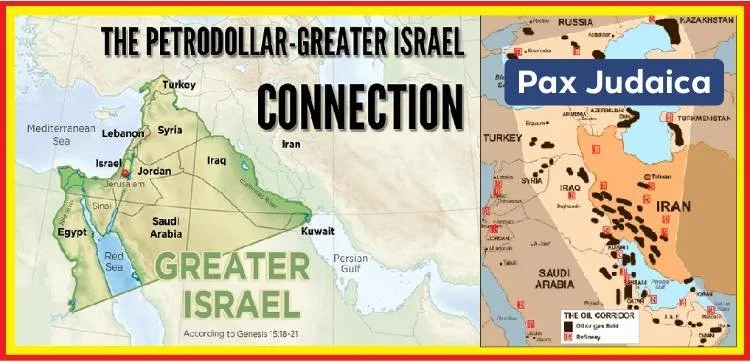
“Pax Judaica represents the shift from American to Israeli hegemony in the Middle East following the US military failure in Iran. This transition is driven by Israeli strategic efficiency, the Greater Israel Project 2026, and the deliberate economic implosion of the US empire to force a regional retreat.”
“The ongoing conflict between the United States and Iran is not a war of equals, but a strategic catalyst for the transition from a decaying Pax Americana to a high-efficiency Pax Judaica. Professor Jiang argues that US military operations are failing due to a "hubris trap," where leadership forces reality to conform to a flawed military strategy. Conversely, Israel is "auditioning" for the role of the new regional empire by demonstrating superior political unity and strategic lethality. The eventual outcome is a US retreat, leaving Pax Judaica as the dominant surveillance and trade architecture in the Middle East.”
Simon Dixon’s argument cuts through the fog. What he describes is not a “challenge” or a “cycle” or a “market imbalance.” It is a regime of controlled indebtedness, a structure designed to keep the population permanently reachable, permanently vulnerable, and permanently manageable. The house, the loan, the card, the rate hike, the bailout, the inflation shock—all of it works together like a single operating system. The public thinks it is living inside an economy. In reality, it is living inside a payment plan.
And this is where the reset enters the picture. Every exhausted empire eventually attempts to repackage its decay as renewal. The debt grows, the middle class thins, the public loses faith, and the people at the top present themselves as stewards of a “new order.” But the structure remains. The slogans change. The faces change. The creditors do not. The old empire does not die so much as mutate, shedding its language while preserving its logic.
That is why these moments feel so ominous. They are not clean transitions. They are transfers of control disguised as historical progress. One ruling arrangement gives way to another, but the machinery of extraction survives intact. The public is told the system is being repaired, when in fact it is being reauthorized. The debt is not reduced. It is rolled forward. The crisis is not resolved. It is managed. And management, in this age, is just another word for control.
What makes the arrangement so effective is its talent for disguising coercion as choice. It offers access, convenience, mobility, and aspiration, then ensures that the cost of participation rises faster than wages and faster than hope. By the time people recognize the trap, they are already inside it. Their labor has been pledged, their future has been discounted, and their lives have been formatted around obligations they did not truly consent to. That is why the language of “debt slave” shocks people — not because it is extreme, but because it is uncomfortably precise.
The deeper scandal is that the system no longer needs to hide its contempt. It can strip wealth upward in broad daylight, inflate itself out of accountability, and then lecture the public about prudence. It can break the social contract and still present itself as the only thing preventing collapse. That is the final trick of the ruling order: it makes itself appear indispensable to the very people it has impoverished.
And that is why the reset matters. Every empire eventually tries to save itself by reorganizing the terms of reality before the public can name what has happened. The old order degrades, the debt swells, the people tire, and then the architects of the next arrangement present themselves as reformers. But the structure remains. The names change. The flag changes. The creditors do not.