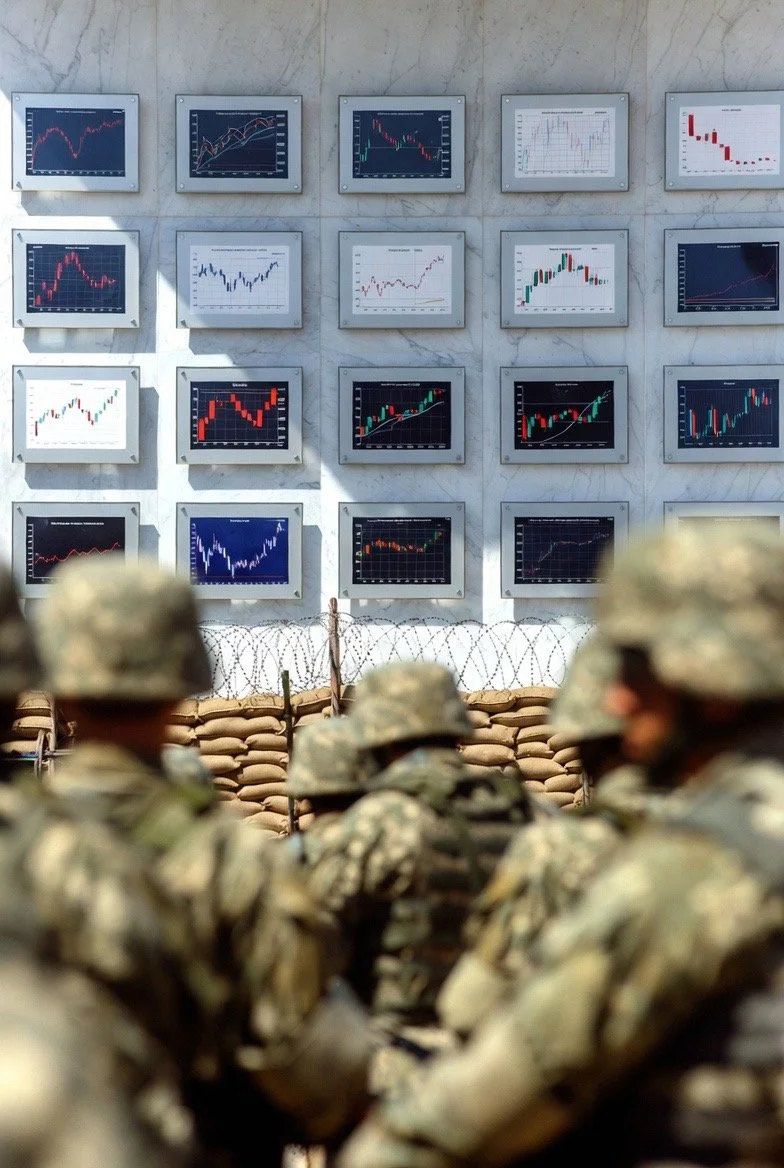
Military Industrial Complex vs. Financial Industrial Complex
The Military-Industrial Complex (MIC) is powerful. It builds the bombs, scripts the conflicts, and ensures the spectacle never ends. But power, in the 21st century, does not ultimately belong to those who wage war. It belongs to those who finance it.
The Financial-Industrial Complex (FIC) operates on a different plane entirely—less visible, less theatrical, and far more decisive. It is not a conspiracy in the cartoon sense, but a system of interlocking interests: central banks, global asset managers, private equity, sovereign funds, and the policy machinery that quietly aligns public authority with private capital.
It does not need to issue commands. It sets the conditions.
The real lever of control is not force, but liquidity. Who gets cheap money. Who gets rolled over. Who gets “rescued.” And who, suddenly and without ceremony, discovers that the market has lost confidence.
This is how modern power works.
BlackRock doesn’t need to run a government to shape outcomes. It sits in the bloodstream of the system—advising central banks, managing trillions, and helping design the very rescue mechanisms that conveniently stabilize the assets it holds. Public and private are no longer opposing categories; they are functions of the same operating system.
And the politicians? They don’t need to be “owned” in some crude, transactional sense. It’s much cleaner than that. They are calibrated. Their range of possible action is bounded by bond markets, capital flows, and the ever-present threat of financial instability. Step too far outside the invisible perimeter, and the punishment is swift, impersonal, and framed as inevitability.
The Military-Industrial Complex still plays its part, of course. It supplies the drama. It keeps the narrative engine running—crisis, threat, intervention, repeat. War is profitable, but more importantly, it is useful. It justifies spending, absorbs surplus production, and provides a perpetual rationale for centralized control.
But endless chaos is bad for business.
The Financial-Industrial Complex requires something more refined: instability with guardrails. Enough conflict to keep capital moving and governments compliant, but not so much that supply chains collapse or debt structures unravel. Destruction, yes—but curated, contained, and ultimately monetizable.
Which brings us to China—the designated rival, the indispensable partner.
The rhetoric says confrontation. The balance sheets say interdependence.
China manufactures the world’s goods. The West consumes them. Capital flows in both directions, even as political narratives harden. A full decoupling would not be a strategic victory; it would be a systemic shock. And the FIC, above all, avoids uncontrolled shocks. It prefers managed crises—the kind that create opportunities without threatening the architecture itself.
So what emerges is not a march toward resolution, but a choreography of tension. Trade wars that never quite sever trade. Sanctions that wound but don’t kill. A rivalry carefully maintained within survivable limits.
Because the system must continue.
And at the center of that system sits the dollar—the global reserve currency, the ultimate instrument of financial gravity. For decades, it has allowed the United States to run deficits without consequence, to export inflation, and to extend its influence far beyond its borders.
But even this arrangement is showing strain.
Debt levels climb. Trust erodes. Alternatives—once unthinkable—are now quietly explored. Not because anyone wants to burn the system down, but because the system, as currently configured, is becoming harder to sustain.
The Financial-Industrial Complex can read the signals. It always does.
And so the conversation shifts—not publicly, not dramatically, but incrementally. Digital currencies. Multipolar reserves. Settlement systems that bypass traditional channels. Not a revolution, but a transition. Not a collapse, but a controlled mutation.
Because the objective is not to preserve the dollar. It is to preserve control.
If the operating system needs to be updated, so be it. The interface may change. The branding may change. But the underlying logic—the centralized management of liquidity, the quiet governance of markets, the insulation of capital from genuine democratic disruption remains intact.
The Military-Industrial Complex will continue to dominate headlines, staging conflicts that feel decisive, historic, existential.
But the real decisions are made elsewhere.
Not on the battlefield, but in balance sheets.
Not through force, but through funding.
And in a world where everything runs on liquidity, the ultimate authority belongs not to those that decide who lives or dies, but what gets enough “oxygen” to keep the system breathing.